GUHP Emerging: The Second Annual Spring Symposia May, 2022
Three events featuring emerging scholars who participated in GUHP’s 2021-22 Mentorship Program as part of our four “Dream Conversations.”
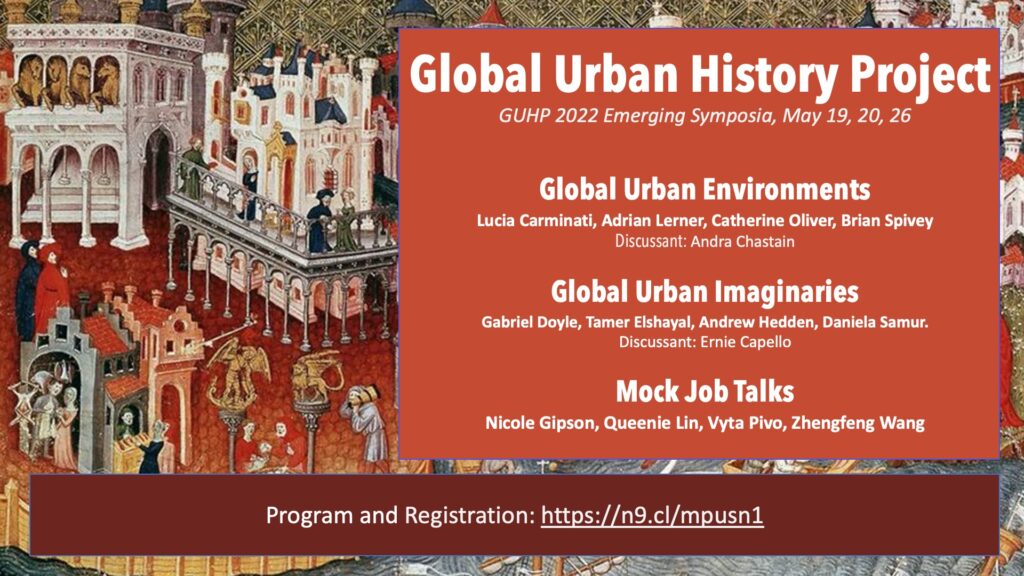
Symposium 1: Global Urban Environments — Thursday, May 19, 2022, 4-6PM UTC
Lucia Carminati, Fecal Matters in the Suez Canal: Bringing Order to the Ordure of Early Port Said
Adrian Lerner, Staying Afloat: Urbanization and Poverty in Cold War Amazonia
Catherine Oliver, Unearthing London’s Urban Barnyard: Galline Life in and beyond Anthropocene Cities
Brian Spivey, Bitter Water: Toxicity, Water, and Science in a Chinese Mining City
Symposium 2: Global Urban Imaginaries — Friday, May 20, 2022, 4-6PM UTC
Gabriel Doyle, The making of an imperial periphery: nature and extraterritoriality in the north of Istanbul in the late Ottoman era
Tamer Elshayal, Shelter, Human Settlements, and the Urban Planet: The Politics of Scale at the United Nations Center for Housing, Building and Planning, 1963-1977
Andrew Hedden, Empire in Need: Seattle and the U.S. Federal Government in the 1970s
Daniela Samur, Bogotá’s World of Books: The Beautification and Commodification of the Urban, 1880s-1920s
Symposium 3: Mock Job Talks — Thursday, May 26, 12-2PM UTC
Nicole Gipson, Welfare Hotels: Race, Gender, and Family Homelessness (1970–1990)
Queenie Lin, Beyond the Dutch Paradigms: The Cosmopolitan Hybrid of the Seventeenth-century Dutch Overseas Settlements in Formosa and New Netherland
Vyta Pivo, Global Politics of Concrete in the Anthropocene
Zhengfeng Wang, Refrigerated Space as Contact Zone: Techno-politics of Food Provisioning in Treaty Port Cities in China
GUHP Emerging 2021: Four Symposia Spotlighting the New Generation of Global Urban Historians
On April 23–24 and May 7–8, 2021, participants in this year’s inaugural GUHP Mentorship Program will present their work at four symposia via a series of 8-minute pre-recorded and pre-circulated presentations.
Panel 1: Who Claims the City?
Chair: Michael Goebel, Freie Universität-Berlin
Discussants: Ademide Adelusi-Adeluyi, University of California Riverside and Sebastian Conrad, Freie Universität-Berlin
Titilola Halimat Somotan (PhD, Columbia; Postdoc, Princeton). Mentor: Carl Nightingale, University at Buffalo: “Ratepayers, Municipal Services, and Decolonization in Lagos, Nigeria.”
Amanda Waterhouse (Indiana University). Mentor: Mark Healey (University of Connecticut) “Radical Architects: University Development & Student Protest in Cold War Colombia”
Archa Girija (The University of British Columbia). Mentor: Guadalupe Garcia, Tulane University.“European Modernity and the Imagination of an Alternate Urbanism in the Indian Ocean”
Panel 2: Infrastructure and Hinterland
Chair: Rosemary Wakeman, Fordham University
Discussants: Saheed Aderinto, Lagos Studies Association and Western Carolina University and Lynn Lees, University of Pennsylvania
Prerna Agarwal (King’s College London). Mentor: Su Lin Lewis (University of Bristol). “Internationalism in India’s docklands, 1920s-1940s”
Ingy Higazy (PhD student, UC Santa Cruz). Mentor: Alexia Yates, Manchester University: “The Problem of Movement: Planning Urban Mobility Infrastructure in Cairo, 1970-Present”
Rustam Khan (PhD student, MIT).M entor: Micah Muscolino, UC San Diego. “Soviet’s Metropolis: Nature and Capital in Socialist Vladivostok, 1930s40s”
Ernest Sewordor (University of Basel). Mentor Constanza Benavides- Castro, Universidad de los Andes: “The “Hinterland Question” Under Planetary Urbanization (PU): Colonial Mining Capitalism, Landscape Operationalisation, and Race in the Gold Coast”
Panel 3: Race, Gender, and Subalternity
Chair: Carl Nightingale, University at Buffalo, SUNY
Discussant: Abosede George, Barnard College and Columbia University
Camille Cordier (Université Lyon Lumière). Mentor: Trevor Burnard, University of Hull: “Space and Time of the “marché des nègres” in Cap-Français in the 18th century”
Aishani Gupta (SUNY Stony Brook). Mentor: Debjani Battacharya, Drexel University. “Women of the Empire at Ajmer’s Dargah: Negotiating the Sacred and the Civic in a Prominent Sufi Pilgrimage Site, ca. 1900-1920”
Chester Arcilla (University of the Philippines-Manila). Mentor: Annelise Orleck, Dartmouth College: “From Community Barricades to Occupy: Radical Urban Subaltern History in the Philippines.”
Panel 4: Building Cities, Building States
Chair: Debjani Bhattacharyya, Drexel University
Discussant: Devika Shankar, University of Hong Kong
Bernard Keo,(Monash University, Australia). Mentor: Michael Vann, California State University, Sacramento. “Colonial City, Global Entanglements: Intra- and Trans-Imperial Networks in George Town, 1786-1937”
Stephen Pascoe (UC Irvine). Mentor: Cyrus Schayegh, Graduate Institute Geneva “Concessionary Imperialism: Infrastructure and the Making of the Contractable State in Post-Ottoman Syria”
Yingchuan Yang (PhD student, Columbia). Mentor: Katherine Zubovich, University at Buffalo. “Walls and Chimneys: Building a City of Production in Early Socialist Beijing”
Read the abstracts for the 2021 symposium:
Prerna Agarwal
Title: Internationalism in India’s docklands, 1920s-1940s
Abstract: The port cities of India – like Calcutta and Bombay are well placed in historiography as birthplaces for nationalist movement. But they have not been studied as sites that produced and sustained political internationalism of wide variety. The themes of Indian urban literature include – governance, modernity, nationalism, and communalism. The growth of regionalism, micro-nationalisms, religious communalism in the post-independence period have all contributed to a parochial understanding of some of the major cities and the politics they produced. A number of scholars have recently argued for an ‘internationalist moment’ for South Asia in the interwar period, this project contributes by examining the role of the two major cities of colonial India. It studies how industrialization, migration and maritime-labour shaped the global outlook and solidarities of its inhabitants, focusing on working-class activism, anti-colonial (communist, pan-Asianist, Islamic) and pro-fascist networks.
Chester Arcilla
Title: Marking Filipino radical urban subaltern histories within global histories of gentrification and housing financialization
Abstract: In 2017, the National Alliance of Urban Poor led some ten thousand Filipino urban poor families in the illegal occupation of around 5,200 empty socialized housing units on the peri-urban province of Bulacan, north of the country‘s capital. Dubbed ‘Occupy Bulacan,’ it is perhaps one of the largest collective housing takeovers in the Global South. Philippine President Rodrigo Duterte condemned the housing takeover and instructed to “shoot them dead” if any more housing units are illegally occupied. This research weaves urban subaltern militant histories with global histories of housing neoliberalization. The rise of empty socialized housing, amid huge unmet housing needs, provided the politico-material opportunities for the housing takeover, which incited state containment. The empty housing phenomenon flows from decades of gentrification, housing commodification, and workers’ precarity. To resist the displacements, militant urban subalterns have defended their communities with organizing, protests, and community barricades. The Occupy Bulacan represents a shift to an offensive urban movement, as the occupiers threatened to deterritorialize capital and state-space and establish a commune. Occupiers are now subjected to intensified military surveillance, illegal arrests, and criminalization of protest actions. Housing commodification and gentrification engender radical subaltern resistances and, consequently, neoliberal fascist containment in the Global South.
Camille Cordier
Title: Shaping a slave city: the space and time of the marché des nègres in Cap-Français, mid-17th century-end of the 18th century
Abstract: In the town of Cap-Français, the economic capital of the French colony of Saint-Domingue, the marché des nègres, located in the main square, was the commercial heart of the region. The expression, used by contemporaries, describes the edible markets in Caribbean cities, supplied by plantation enslaved. By studying this urban institution, I wish to show how enslaved, through their mercantile activity, shaped the space and time of Cap-Français, and how, in return, the administration tried to contain it to fit it into the city. The ubiquity of slavery conditioned the policies of supply and urban planning, as city dwellers were dependent on plantation enslaved for their food supply. In order to prevent food shortages, the colonial authorities, whose political culture was forged in France, adapted the principles of urban planning and market regulation to the colonial context. Through cartographic and administrative sources, the Black market appears as the result of negotiations between administrators, traders and buyers. Far from being merely the product of an imperial vision, the Caribbean city is also the product of the action of the colony’s inhabitants. As the driving force behind the economic and physical transformations of the city, the Black market defines the Creole urbanity.
Archa Girija
Title: Early European Modernity and the Imagination of an Alternate Urbanism in the Indian Ocean
Abstract: My paper focus is on an important player in the Indian Ocean of the early modern period- the port of Calicut, on the south-west coast of India. Calicut was the primary hub of the pepper trade, which was the most important commodity of the early modern Indian Ocean trade, the cardinal destination of the first European ventures, and functioned as a cosmopolitan locus in the global trade. Most of the literature assumes that Calicut lost its predominance with the arrival of the European powers. However, this is mainly due to the use of European sources which define an early modern port city exclusively based on infrastructure and aesthetics developed under European purview. But port cities like Calicut attempted to resist and challenge the European monopolistic and imperial efforts and continued to hold their commercial importance. My paper attempts to examine an alternate non-imperial model of an early modern port city by focusing on the economic, social, and cultural realms of it. If we look at the fifteenth and sixteenth-century descriptions of Calicut, two important features were identified as the characteristics of urbanism: commercial significance and cosmopolitanism. These features continued in the later periods, rather than declining. This paper argues that it was the definition of urbanism changing drastically in the domain of the European imperial projects, not the non-European cities.
Aishani Gupta
Title: Women of the Empire at Ajmer’s Dargah: negotiating the sacred and the civic in a prominent Sufi pilgrimage site, ca. 1900-1920
Abstract: This paper examines how gendered power tussles in sacred spaces such as the early modern Sufi shrine of Muin al-Din Chishti (d. 1236 CE) in Ajmer, were characteristic of modern urbanisms in the empire. I present case studies of four women who visited the shrine in western India between 1908 and 1918. The first is a native courtesan from Lucknow, who petitioned the British Government to claim maintenance from the Sajjada-Nashin (the biological descent of the Sufi saint buried there). The second is a Muslim lady who complained to the colonial officials about being tortured and ill-treated by her Sufi in-laws. The third is a British lady, the wife of a senior official, whose molestation by Khadims (keepers of the shrine) was deftly brushed under the carpet by the colonial administration. The fourth is Queen-Empress Mary, who granted royal patronage to the shrine by donating money, which was then used to build an ablution tank and called the Victoria Tank. I argue that both colonized and imperial women at specific nodes of the empire which had parallel forms of authority such as sacred spaces used those very systems of authority, often against each other, to make their prerogatives heard.
Ingy Higazi
Title: The Problem of Movement: Planning Urban Mobility Infrastructure in Cairo, 1970-Present
Abstract: This paper investigates the politics of urban mobility and infrastructure in post-1970s Cairo. It takes the case of the Greater Cairo Ring Road (constructed between 1986 and 2005), part of Egypt’s project of capitalist restructuring and state-making beginning in 1974 (Infitah). The Ring Road’s construction was intended to: alleviate urban crowdedness, accelerate desert development, and contain urban encroachment on the Nile Delta’s dwindling fertile land. Yet, it facilitated an unprecedented erosion of land fit for agriculture and led to the emergence of Cairo’s peri-urban belt and border: the spatially and geographically peripheral rural-urban communities that surround the city and supply the majority of its waged labor. This paper draws on policy documents, press archives, and interviews with urban planners, officials, and private developers to reconstruct an urban history of the Ring Road. By studying how planning and constructing the Ring Road articulated and re-configured relations of space, capital, and coercion in Cairo and its peripheries, I analyze how and why mobility in the city was planned and for whom. I argue that the Road was planned not only as an infrastructure to facilitate the flow of global capital and to cater to a growing automobile economy (Dodson 2017; Barak 2019; Taha 2002), but also as a state effort to govern and discipline the production of urban space and movement(s) in the city and its rural and desert peripheries.
Bernard Keo
Title: Colonial City, Global Entanglements: Intra- and Trans-Imperial Networks in George Town, 1786-1937
Abstract: From its foundation as a British settlement in 1786, the city of George Town on the island of Penang quickly became enmeshed in complex circulations of trade, people, and ideas. By the end of the nineteenth century, George Town had developed a multicultural and polyglot society that included a kaleidoscopic mix of ethnic groups. This paper investigates the relationship between George Town’s cosmopolitan population and its development into a global hub for commercial, intellectual, and physical interchange over the course of British rule. In particular, I argue that the city’s success depended on intricate webs of personal and professional connections developed by George Town’s residents across Southeast Asia and beyond. Building on recent scholarship exploring of Penang’s regional networks of trade and knowledge (Yeoh et al., 2009; Zabielskis et al., 2017), I examine how one particular community, the Peranakan Chinese, built and leveraged networks across the British, Dutch, and Japanese empires. By exploring these intra- and trans-imperial networks, this paper integrates George Town into global history and presents fresh perspectives on both Malaysian and British imperial history. In particula, I make the case for studying colonial cities like George Town not as passive nodes of empire but as active sites within overlapping imperial networks.
Rustam Khan
Title: Greening the Soviet City: Vladivostok and the Making of Urbanity through Coal and Rivers, 1938 – 1953
Abstract: In this presentation, I display how Soviet cities couldn’t grow without producing and encapsulating ecological energies such as coal and rivers from a non-urban sphere. I do so by focusing on Vladivostok, a city squeezed in between China, North Korea, and the Pacific Ocean during the late Stalinist era. Much of the historiography into socialist built environments has almost exclusively revolved around the essence of ideology and modernity to make sense of urbanization. In contrast, I highlight how cities, whatever their political regimes, could only develop by enabling a seamless circulation of green power between urban cores and rural hinterlands. Such green power allowed to build a public hygiene infrastructure to accommodate a growing working class. It also allowed to set up an electric grid to stimulate industrial growth. Such a conceptual orientation feeds off the insights about high modernism (James C Scott) and the urban-environmental nexus in the making of cities (William Cronon). In particular, I hope to stimulate comparative investigations and critically examine the agency of nonhuman factors in shaping urban life under socialism.
Stephen Joseph Pascoe
Title: Concessionary Imperialism: Infrastructure and the Making of the Contractable State in Post-Ottoman Syria
Abstract: This paper presents a slice of my ongoing research. In the larger project, I argue that foreign-capitalized infrastructure companies during the Age of Steam practiced a form of “concessionary imperialism”. By this term, I mean the attempt by such companies and their allies to engineer long-term contractual arrangements to build, operate and control vital urban and regional infrastructure (electricity, railways, roads, ports) understood to be indispensable to modern social and economic life. In this paper, I examine the relationship between the French imperial state and the concessionary companies that had been active in Ottoman Syria prior to World War I. I argue that French imperial planners crafted a “contractable state”, one which institutionalised the outsourcing of vital infrastructure via contracts that were intentionally drafted to outlive the temporary system of mandate government imagined after the war. While the strategic alliance between colonial bureaucrats and the representatives of multinational corporations was critical to the formation of the interwar mandate state in French (and British) mandated territories, I argue that this cohabitation was short lived. As such, my thesis challenges simplistic formulations of alliance of state and capital in early twentieth century imperial rule while sketching the fault lines for anti-imperial mobilisation beyond the framing of anti-imperial struggle as a solely national affair targeting state power.
Ernest Sewordor
Title: The “Hinterland Question” under Planetary Urbanization (PU): Colonial Mining Capitalism, Landscape Operationalisation, and Race in the Gold Coast
Abstract: This project takes its overall theoretical inspiration from the notion of Planetary Urbanisation; built on the chief claim that today’s urban reality has become ‘ex-centric’ hence the need for a de-centred epistemology of the urban (i.e., not take the city as tout court, a unit of the urban). Similarly, this work foregrounds mining enclaves in the Gold Coast (GC) within a conceptual frame that focus specifically on their industrial urban make-up via processes of unequal capitalist transformation of landscape (imbricating both city and hinterland spaces), while accounting for their embeddedness in worldwide intensification of colonial capitalism within the British empire. From the vantage point of GC’s hinterlands, I intervene in urban scholarship by examining how mechanised mining and its associated infrastructures (e.g., regulatory regimes) reconfigured territory by critically contesting a linear view of how global circulations of capitalism (presumably, Western) transformed urban space on a trans-local scale, and also highlight how, in the process, capitalism was racialised to disadvantage colonial subjects, during the first half of the twentieth century. Without positioning colonial subjects as helpless victims of racialised capitalism, the study ultimately traces histories of intersections, conflicts, dispossession, and dialectics to demonstrate indigenous agency as alien capital operationalised landscape.
Titilola Halimat Somotan
Title: “We Voters in this Area Want Service for our Money”: Lagos Ratepayers and the Struggles over Municipal Administration in the Decolonization Era
Abstract: As Nigerians struggled for independence from British colonial rule, Lagos residents, who often described themselves as ratepayers, and voters demanded social services from the Lagos Town Council. Tenants and landlords from diverse class, ethnic, and gender backgrounds created ratepayers’ organizations to influence municipal policies. Drawing from newspapers, novels, and musical recordings, this paper examines how Lagos ratepayers framed their requests and debated the necessities of council’s laws. While historians of decolonization have shown how urban dwellers shaped nationalist movements and defied colonial administration’s building policies, I study how city residents engaged with municipal government. By demanding resources such as water and sewage collection, Lagosians made everyday conflicts over urban social services central to how urban inhabitants experienced and contested the transition from colonial rule to independence.
Amanda Waterhouse
Title: Radical Architects: University Development & Student Protest in Cold War Colombia
Abstract: This article examines architecture as a contested form of international development in Colombia during the Cold War. Focusing on the University of Valle in Cali, Colombia, it shows how Colombian and U.S. officials conscripted architects into the development of modern university facilities during the 1960s. They also funded the architecture school to produce architects engaged with community development needs. But architecture at the University of Valle was more than a facilitator of development; it also became a site of contestation. Architecture faculty and students levied formal critiques of the programs and techniques that administrators and officials advocated. The architecture school became one center of a radical student protest movement that peaked—and saw violent state repression—in 1971. It fought for autonomy and against elitism, imperialism, and international development. The very architecture students and faculty meant to champion architecture that fulfilled elite Colombian and U.S. visions of development, then, in fact confounded top-down and outside control of both their discipline and public spaces.
Yingchuan Yang
Title: Walls and Chimneys: Building a City of Production in Early Socialist Beijing
Abstract: While Liang Sicheng advocated for the construction of a separate administrative district in Beijing’s suburbs in 1951, Mao Zedong demanded to turn the capital into “a city full of chimneys” and to build the administrative center right in the old city. Instead of blaming Mao and his cadres for the destruction of “old Beijing,” this essay takes seriously the socialist vision of urbanization. Liang’s proposal failed for being fundamentally at odds with the Communist Party’s plan of transforming Beijing into a city of production that underpinned the development not only industry but also mobilizational politics. New space facilitated transportation and industrial production, and Beijing’s cityscape was further associated with the emancipation of proletarians, whose new life could be best found at Longxugou, a refurbished drainage that captured the success of socialist governance. Beijing in the 1950s demonstrated the Party’s grand ambitions and adroit tactics of reconfiguring urban China, a setting unfamiliar to it before 1949.
Participants in GUHP’s Inaugural Mentorship Program, 2020-2021
I. Cities and Imperial Networks Workshop
Organizers: Emma Hart, St. Andrews University; Mariana Dantas, Ohio University
Camille Cordier, Université Lyon Lumière, “The Making of the “Paris des Antilles”: the Role of the Sailors’ and Enslaved Markets in the Integration of Cap-Français into the World of Goods of the 18th Century
Mentor: Trevor Burnard, University of Hull, UK
Bernard Keo, Monash University, Australia, “Colonial City, Global Entanglements: Intra- and Trans-Imperial Networks in George Town, 1786-1914”
Mentor: Michael Vann, California State University, Sacramento
Archa N. Girija,The University of British Columbia, “Early European Modernity and the Imagination of an Alternate Urbanism in the Indian Ocean”
Mentor: Guadalupe Garcia, Tulane University
Aishani Gupta, SUNY at Stony Brook, “Colonial Women in Ajmer’s Dargah Sharif: gendered identities, exploitation and inscription of power in a Sufi sacred space”
Mentor: Debjani Battacharya, Drexel University
Ernest Sewordor, University of Basel, Switzerland, “Mechanised Mining, Infrastructure, and the Evolution of Gold Coast’s Urban Space, c. 1900-1957”
Mentor: Constanza Castro Benavides, Universidad de los Andes, Colombia
II. Urban Forms and Informalities Workshop
Convenors: Tracy Neumann, Wayne State University and Kristin Stapleton, University at Buffalo
Ingy Higazy (PhD student, UC Santa Cruz), “Urban, But Not Quite: Peripheral Living Along the Greater Cairo Ring Road”
Mentor: Alexia Yates, Manchester University
Rustam Khan (PhD student, MIT), “The (Un-)Making of a Commodity Frontier: Soviet Vladivostok in Northeast Asia, 1930s-1950s”
Mentor: Micah Muscolino, UC San Diego
Halimat Somotan (PhD, Columbia University; Postdoc, Princeton), “The Decolonizing City: Popular Politics and Municipal Administration in Lagos Nigeria, 1950-1972”
Mentor: Carl Nightingale, University at Buffalo
Yingchuan Yang (PhD student, Columbia), “A City Full of Chimneys: Urban Planning and the Form of Mobilizational Politics in 1950s Beijing”
Mentor: Katherine Zubovich, University at Buffalo
III. Cities and Radicalism Workshop
Workshop Organizers: Nancy Kwak, University of California San Diego and Michael Goebel, Graduate Institute of Geneva
Prerna Agarwal (King’s College London), “Decolonising Calcutta: moments of labour radicalism in the late 1940s”
Mentor: Su Lin Lewis (University of Bristol)
Chester Arcilla (University of the Philippines-Manila), “Marking Militant Urban Subaltern Mobilizations and State Containment Within Global Histories of Gentrification and Financialization”
Mentor: Annelise Orleck (Dartmouth College)
Stephen Pascoe (UC Irvine), “Concessionary Imperialism and Its Discontents”
Mentor: Cyrus Schayegh (Graduate Institute Geneva)
Yessenia Puentes (Pontificia Universidad Católicade de Chile), “Adapting Urban Space to the Neoliberal Way of Living: Community and Mining Heritage in Coronel, Chile (1973-2018)”
Mentor: Camilo Trumper (University at Buffalo)
Amanda Waterhouse (Indiana University), “Radical Architects: University Development and Student Protest in Cold War Colombia”